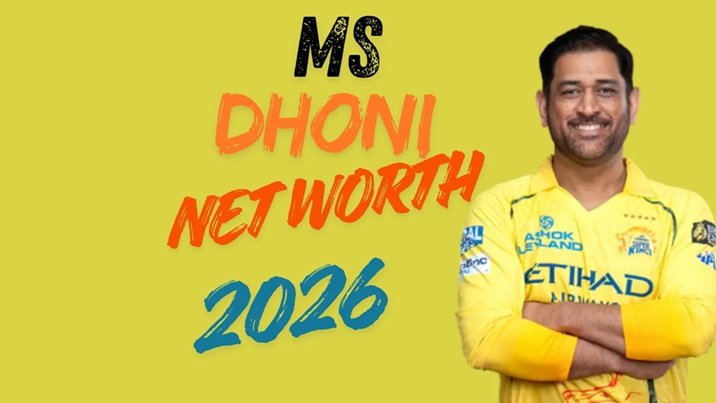
MS Dhoni’s net worth is widely estimated at around ₹1,000 crore, though no public audited statement sets out a definitive figure. The estimate reflects much more than his playing income: it combines his long international career, IPL contracts, endorsement work and business interests. That variety is the key to understanding his financial standing. Rather than depending on one salary stream, Dhoni built commercial value over many years through performance, leadership, recognisability and an unusually durable connection with cricket followers.
Why a precise net-worth figure is difficult to verify
Net worth is not the same as salary, income or cash held in a bank account. It is generally understood as the estimated value of a person’s assets after accounting for liabilities. For a major sportsperson, that may include business stakes, property, investments, past earnings and income rights, alongside any debt. Much of this information is private, so published figures are necessarily estimates rather than confirmed financial disclosures.
News18 estimated Dhoni’s net worth at around ₹1,000 crore in August 2025. Jagran Josh placed the estimate between ₹1,000 crore and ₹1,063 crore in an article updated in September 2026. The close range gives a useful broad indication, but it should not be read as an exact valuation. Asset values can change, private business stakes are not always public and endorsement agreements usually do not disclose their complete commercial terms.
A responsible way to view the number is therefore as an approximation of the value built across a long sporting and commercial career. It does not reveal precisely how much came from each contract, company or asset category. The more reliable conclusion is that Dhoni’s financial profile has several major sources rather than a single headline deal.
IPL earnings and the value of longevity
The IPL has been central to Dhoni’s commercial identity. News18 identified IPL contracts as one of the foundations of his earnings, alongside endorsements and business ventures. His long association with Chennai Super Kings gave him sustained visibility within India’s most prominent franchise competition, making the league important not only as a playing-income source but also as a platform for building public recognition.
A player’s IPL value cannot be measured only by the fee attached to one season. A long-running role with a high-profile team can create value in several connected ways. Match appearances keep an athlete in front of national audiences, while leadership and team success strengthen the public image that commercial partners often seek. In Dhoni’s case, his association with Chennai Super Kings became a defining part of his career narrative.
That is also why an IPL salary and net worth should never be treated as interchangeable terms. An IPL contract is a component of annual cricket income. Net worth is a much broader estimate that can incorporate earnings accumulated across previous seasons, business holdings and commercial work outside the tournament. Even a high-profile IPL deal cannot, on its own, explain an estimated fortune of this scale.
For supporters studying upcoming line-ups and player roles, past reputation is only one part of the picture. Match conditions, team combinations and confirmed selections matter more for any individual game. Resources that discuss a today dream11 best team can be useful when considered alongside current team news and a clear understanding that cricket remains unpredictable.
International cricket created the foundation
Dhoni’s stature was established through international cricket before the scale of his off-field commercial opportunities became apparent. Jagran Josh noted that he captained India in every format and won three major ICC trophies. Those achievements helped make him one of the most recognisable figures in Indian sport and gave his name a meaning beyond runs, catches or individual match results.
Leadership matters commercially because it creates a public identity that can endure after a player’s peak years. Dhoni’s calm on-field persona and reputation for decision-making became closely tied to his image. News18 described him as known for composure and leadership, qualities that have supported his enduring profile as a commercial figure.
International cricket also offers a different kind of value from a domestic franchise competition. It places a player before a national audience, often across many seasons and formats. Successful captains can become associated with landmark wins, collective memories and a sense of reliability. Such visibility does not automatically produce wealth, but it makes future opportunities in endorsements and business more plausible.
His formal retirement from international cricket was announced on 15 August 2020, according to the biographical information listed by Wikipedia. Retirement from international matches did not erase the value of the brand built during those years. For elite athletes, a major career often continues to generate commercial relevance through public appearances, partnerships and business activity.
Endorsements: the long-term commercial engine
Endorsements are regularly cited as a significant contributor to Dhoni’s estimated wealth. News18 referred to his numerous endorsements, while Jagran Josh noted that he has many endorsement agreements. The precise value, duration and terms of those arrangements are not set out in the available reports, so it would be misleading to attach unsupported figures to individual deals.
What can be said is that endorsement income differs from a cricket contract in important ways. A sports contract pays for playing or representing a team during a defined period. An endorsement arrangement draws value from the player’s public credibility, familiarity and ability to connect a brand with particular qualities. For Dhoni, the association with composure, leadership and longevity has been commercially useful.
Endorsement potential may also last longer than active international participation. A retired athlete can remain a familiar face if the public association remains strong and consistent. This is especially relevant in Indian cricket, where fans often maintain an emotional connection with leading players long after their final international appearance.
However, it is important not to assume that every public association is a permanent or current deal. Advertising campaigns change, contracts expire and brands revise their plans. The overall point is not that every endorsement continues indefinitely, but that years of high visibility created a substantial commercial base outside cricket salaries.
Business interests add a separate layer
Published reports also point to business ventures as part of Dhoni’s wealth. News18 included business ventures among the sources behind its ₹1,000 crore estimate. Jagran Josh described him as the owner of a lifestyle venture and a co-owner of a Chennai-based football club. These interests illustrate why discussions of his finances cannot be reduced to match payments alone.
Business ownership is different from endorsement income. An endorsement typically pays a person for association with a brand, while ownership can mean holding an interest in an enterprise whose value may rise or fall over time. The return may come through profits, an eventual sale, dividends or growth in the underlying value of a stake. It can also involve risk, costs and periods without immediate returns.
Because the detailed ownership structures and valuations are not publicly laid out in the available reports, there is no sound basis for claiming exact amounts from these ventures. Still, their role is important conceptually. They show a shift from earning as a player to participating in commercial activity that can operate beyond a playing schedule.
This diversified model is common among highly visible sportspeople, but individual outcomes differ considerably. The lesson from Dhoni’s case is not that every athlete can replicate it. Rather, it shows how a reputation developed in sport can provide a foundation for opportunities in other sectors when supported by long-term public trust.
What the estimates really indicate
The most meaningful part of the MS Dhoni net-worth conversation is the combination of income streams. IPL contracts supplied high-profile cricket earnings. International achievements established a national profile. Endorsements converted that recognition into commercial relationships, while business interests added another potential source of value. Each element reinforced the others over time.
It is also worth separating career earnings from net worth. Career earnings refer to money received across playing contracts, appearances and commercial work over the years. Net worth is a snapshot estimate that accounts for what may remain, what has been invested and what assets or liabilities exist at a particular point. Someone can have huge career earnings without retaining the same amount as personal wealth.
Conclusion
Dhoni’s estimated net worth of roughly ₹1,000 crore is best understood as a broad, unverified estimate of a career built on far more than cricket salary. IPL contracts, international success, endorsements and business interests all form part of the picture. The exact total may be private, but the larger story is clear: sustained sporting excellence and a durable public identity created financial opportunities that extended well beyond the boundary.