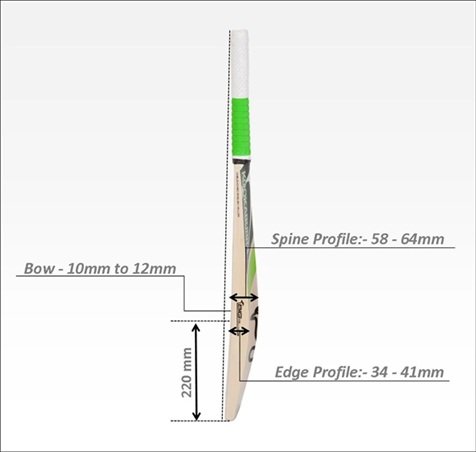
The right cricket bat size is chosen primarily by the player’s height and then confirmed through how naturally the bat works in a batting stance. Age and body weight can offer background context, especially for young players, but neither is as reliable as height, reach and control. A bat that is slightly small is usually easier to manage than one that is too large, particularly for a junior developing sound batting habits.
Cricket bat size chart by height
Measure the player barefoot before using a size chart. Stand flat against a wall with heels, upper back and the back of the head touching it, then use a level object on the head to mark the height. Measuring carefully matters because a difference of only a few centimetres can put a player on either side of a size transition.
| Bat size | Player height | Player height in cm | Approximate bat length |
| Size 1 | Under 4 ft | Under 122 cm | 61 cm |
| Size 2 | 4 ft–4 ft 3 in | 122–130 cm | 64 cm |
| Size 3 | 4 ft 3 in–4 ft 6 in | 130–137 cm | 67 cm |
| Size 4 | 4 ft 6 in–4 ft 9 in | 137–145 cm | 70 cm |
| Size 5 | 4 ft 9 in–5 ft 1 in | 145–155 cm | 73 cm |
| Size 6 | 5 ft 1 in–5 ft 4 in | 155–163 cm | 76 cm |
| Harrow | 5 ft 4 in–5 ft 6 in | 163–168 cm | 79 cm |
| Short Handle | 5 ft 6 in–6 ft | 168–183 cm | 85 cm |
| Long Handle | 6 ft–6 ft 4 in | 183–193 cm | 87 cm |
| Long Blade | Over 6 ft 4 in | Over 193 cm | 87 cm |
This is a starting guide rather than a fixed rule. Two players of the same height may have different arm lengths, strengths and batting preferences. A player exactly on a boundary between sizes should test both options instead of automatically choosing the larger one.
Why height matters more than age
Age-based charts are convenient, but children of the same age can have very different heights. A 10-year-old who is 4 ft 7 in, for example, is likely to need a different bat from another 10-year-old who is 5 ft tall. Choosing by birthday alone risks giving one player a bat that is either too short or too long.
For juniors, a bat that is too big can affect movement and technique. The player may grip too tightly to control it, shorten the backlift or rely too much on the bottom hand. They may also change their posture by leaning, crouching or adjusting their stance simply to get the toe of the bat onto the ground.
Those adjustments can become habitual over time. That is why buying a larger bat “to grow into” is not usually a good solution. A player will eventually outgrow a correctly sized bat, but it is better to use equipment that can be controlled properly while learning the game.
Use age only as a broad checkpoint
Age still has limited practical value when buying a first bat or planning for future growth. Younger children will generally begin in the smaller numbered sizes, while teenage players often move through Size 6, Harrow and adult bats. However, it should never overrule a measured height and a practical fit test.
Parents and coaches can treat age as a prompt to remeasure a growing player rather than as the deciding factor. A child who has had a growth spurt may need a new size sooner than expected, while another may remain comfortable with the same size for longer.
Does body weight determine cricket bat size?
Body weight does not determine cricket bat length. A player’s height and reach determine whether a bat is the right physical size, while strength and comfort influence the bat weight and pickup. These are separate decisions.
A taller player may be light in build but still require a longer bat because of their height. Equally, a shorter but stronger player does not necessarily need a longer adult bat. Moving up in length merely because a player is strong can make the bat harder to control in the stance and through the swing.
Bat weight matters after length has been settled. A player should be able to lift the bat smoothly and play controlled practice strokes without changing their posture. The feel of a bat in motion, often described as its pickup, can differ even when two bats have similar scale weights.
Two simple checks for the right fit
A size chart gets most players close to the correct answer, but physical checks are especially useful at transition points. Test the bat in the cricket shoes normally worn for batting, since footwear can alter the result slightly.
The hip test
Stand upright with the bat held vertically beside the leg and the toe resting on the floor close to the foot. The top of the handle should reach around the hip or just below the waist. If it only reaches the knee or mid-thigh, the bat is likely too small. If it comes up towards the navel or chest, it is likely too large.
This is a quick test, but it should not be the only one. It assesses the player standing upright rather than batting, so the next check is more useful for deciding between two nearby sizes.
The stance and backlift test
Take a normal batting stance with the bat resting naturally near the back foot. The toe should meet the ground without the player bending the knees unusually, changing the angle of the bat or forcing the hands into an awkward position.
Next, play a slow backlift and a gentle forward defensive movement. The bat should move freely, with no need to alter posture. If the handle catches the forearm, the player has to crouch, or the toe drags through the shot, the bat may be too long. If the player feels cramped or lacks reach, it may be too short.
For those who also enjoy studying upcoming games, a Cricket Match Prediction can add context around teams and conditions, but on the field a comfortable and controllable bat remains a more immediate part of a player’s preparation.
Understanding Harrow, Short Handle and longer adult bats
The Harrow is an important transition size between Size 6 and the standard adult Short Handle. It suits players from about 5 ft 4 in to 5 ft 6 in, including younger players who have outgrown Size 6 and shorter adults who find a Short Handle too long or heavy.
Skipping directly from Size 6 to Short Handle can be a substantial jump in both length and weight. A player who feels cramped with Size 6 but cannot yet control a Short Handle may find Harrow the most balanced option. It is not merely a junior compromise; for some adult players, it is the better-fitting bat.
Short Handle is the standard adult size and is generally suited to players between 5 ft 6 in and 6 ft. Long Handle and Long Blade are different solutions rather than interchangeable versions of a larger bat.
A Long Handle has the same blade length as a Short Handle but a longer handle. It can help a taller player who feels stooped in a Short Handle stance. A Long Blade keeps a standard handle but adds length to the blade, increasing the hitting area and placing more willow towards the toe. That can make it feel heavier during the swing.
Common mistakes when choosing a bat
The most frequent mistake is selecting a large bat for a child to use over several years. While it may appear economical, poor control can make practice less enjoyable and encourage awkward technique. A smaller bat that feels manageable is typically the safer choice until the player genuinely grows into the next size.
Another mistake is assuming all tall players need a Long Handle or Long Blade. Many players above 6 ft may still prefer the control of a Short Handle. The deciding point is whether they can take a natural stance and play their shots comfortably, not height alone.
Finally, do not choose by label alone. Sizes can guide the purchase, but the player’s own stance, reach and ability to lift the bat smoothly should settle the final decision.
Conclusion
A cricket bat size chart is most useful when height leads the choice and practical testing confirms it. Measure carefully, avoid buying overly large bats for juniors, and consider Harrow at the Size 6-to-adult transition. The best bat is not simply the longest one a player can hold; it is the one that supports a natural stance, controlled swing and confident batting.