
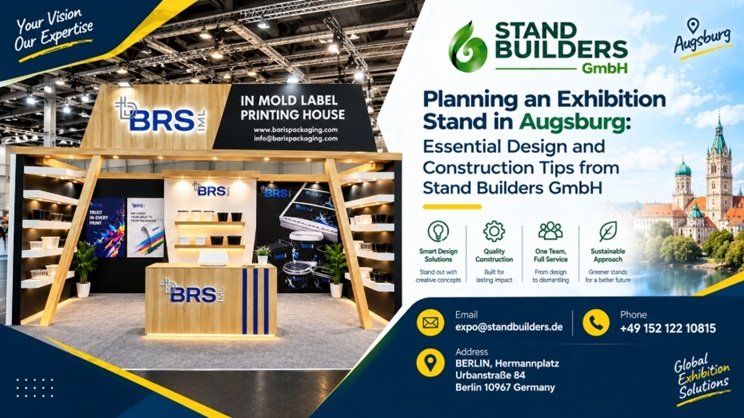
A trade fair booth is often the first physical interaction between a business and its potential customers. Its design influences how visitors discover products, understand services, and communicate with company representatives. For exhibitors searching for an exhibition stand design company in Augsburg, the important consideration is not simply how the stand will look, but how effectively it will function throughout the event. Stand Builders GmbH provides exhibition stand design and construction services in Augsburg, helping businesses develop exhibition spaces that combine branding, practical layouts, and coordinated project execution.
Augsburg offers opportunities for businesses participating in specialised industrial, technical, and consumer exhibitions. Whether a company is presenting manufacturing equipment, introducing new technology, or connecting with potential distributors, the exhibition stand should reflect its specific objectives. Understanding how booth design decisions influence the overall exhibiting experience can help businesses prepare more effectively.
The Exhibition Floor Is a Working Business Environment
Exhibition stands are sometimes treated primarily as advertising displays. In reality, they function as temporary workplaces where sales representatives, technical specialists, and potential customers interact throughout the event.
A stand may need to accommodate several activities simultaneously. One visitor might be watching a product demonstration while another discusses pricing with a representative. Meanwhile, staff members may be welcoming new visitors or preparing presentation materials.
This makes spatial planning particularly important. A visually attractive stand can become difficult to use when counters obstruct entrances, furniture occupies demonstration areas, or meeting spaces lack sufficient privacy.
Effective design begins by identifying how the business intends to use the space. The resulting layout should support those activities without unnecessary complexity.
Understanding the Augsburg Exhibition Environment
Augsburg’s exhibition landscape includes events serving technical industries, specialist businesses, and general consumers. Exhibitors may encounter audiences with very different expectations depending on the event.
At a technical exhibition, visitors may want detailed explanations, product specifications, and opportunities to speak with specialists. At a consumer-focused event, product accessibility, visual communication, and welcoming presentation areas may receive greater attention.
For example, events such as Coiltech Deutschland focus on specialised industrial audiences, while other Augsburg exhibitions address broader visitor interests.
The stand design should respond to the nature of the event rather than follow a generic layout.
Exhibitors must also review the venue’s technical documentation. Building heights, structural requirements, electrical connections, fire safety provisions, and installation schedules can influence what is possible within the allocated space.
Four Exhibition Stand Services Offered by Stand Builders GmbH
Different businesses require different exhibition structures. Stand Builders GmbH offers four main stand categories designed to accommodate varying presentation needs, budgets, and participation strategies.
1. Custom Exhibition Stands: When the Brand Needs Its Own Environment
A custom exhibition stand is developed around the exhibitor’s individual requirements rather than a fixed standard layout.
This approach is useful for businesses introducing important products, presenting specialised equipment, or creating a distinctive brand environment. Designers can consider the company’s visual identity, product dimensions, visitor flow, and meeting requirements when developing the concept.
Customisation may involve specially designed reception counters, product displays, branded walls, lighting arrangements, and integrated presentation technology.
For Augsburg exhibitors, the advantage is flexibility. The stand can be organised around the company’s actual activities instead of forcing those activities into a predetermined structure.
However, custom construction requires detailed planning. Materials, production schedules, technical requirements, and future reuse possibilities should be discussed before the design is finalised.
2. Modular Exhibition Stands: Adaptability for Repeated Participation
Some companies attend several exhibitions every year, often with different stand dimensions and floor plans.
Modular exhibition stands address this challenge through reusable structural components that can be assembled in different configurations.
The same system may be adapted for a smaller regional event or expanded for a larger exhibition, provided the components and design permit it.
This flexibility can be useful for businesses seeking a consistent brand presentation across multiple trade fairs.
Modular construction also creates opportunities to update graphics, rearrange display areas, and modify furniture without replacing every structural element.
Nevertheless, exhibitors should consider storage, transportation, maintenance, and compatibility with future venues before selecting a modular system.
3. Double-Decker Exhibition Stands: Organising Activities Across Two Levels
When floor space is limited but a business requires several functional areas, a double-decker exhibition stand may be worth considering.
These structures introduce an upper level that can accommodate meeting rooms, hospitality areas, or other approved functions. The ground floor can remain available for visitor reception, product demonstrations, and general interaction.
Separating activities between levels may help businesses manage public and private discussions more effectively.
However, double-decker stands involve additional engineering and safety considerations. Structural calculations, stairways, accessibility requirements, and organiser approvals must be addressed before construction.
The suitability of this format depends on the exhibition venue’s regulations, the allocated stand area, and the exhibitor’s budget.
4. Country Pavilion Stands: Presenting Multiple Businesses Together
Country pavilion stands are designed for coordinated participation by groups of exhibitors.
They may be used by trade associations, export organisations, industry groups, or businesses representing a particular country.
Unlike an individual booth, a pavilion must balance two objectives: creating a unified overall presentation and allowing participating companies to communicate their separate identities.
This may involve shared reception areas, coordinated signage, individual display sections, meeting spaces, and consistent architectural elements.
Stand Builders GmbH includes country pavilion construction among its exhibition services, supporting group exhibition requirements where several participants share a larger presentation environment.
How Design Decisions Affect Visitor Movement
An effective exhibition layout should make the visitor’s next step feel natural.
The entrance should be identifiable, important displays should be accessible, and visitors should be able to understand where to ask questions or request demonstrations.
Graphics play a major role in this process. Clear branding communicates who the exhibitor is, while carefully selected messages explain what the company offers.
Lighting also influences how products and display areas are perceived. Focused lighting can draw attention to selected features, while general illumination helps create a comfortable environment.
The Augsburg service page highlights the use of exhibition graphics, lighting, and technology-integrated displays. Depending on the project, interactive screens or digital presentations can provide visitors with additional product information.
These elements work best when they support a clear communication objective rather than simply making the stand appear more elaborate.
Why Manufacturing and Project Coordination Matter
A completed exhibition stand depends on the relationship between the approved design and its physical construction.
Stand Builders GmbH describes its in-house production facilities as part of its exhibition stand services. This allows the company to coordinate manufacturing requirements with the proposed design.
The project begins with understanding the exhibitor’s objectives and developing a concept. Three-dimensional design helps communicate the intended layout before construction begins.
Once the design is approved, production involves preparing the necessary structural and display components. Graphics and other presentation elements are incorporated according to the project specifications.
After manufacturing, the components must be packaged, transported, and installed at the exhibition venue.
For businesses evaluating the best Stand booth in Germany for their requirements, it is useful to examine how these activities are managed, which services are included in the quotation, and who coordinates the project.
A well-organised construction process is especially important when installation must be completed within a limited venue access period.
The Details That Should Be Confirmed Before Production
Many exhibition problems originate from incomplete information rather than complicated construction.
An exhibitor may approve an attractive design without confirming the dimensions of a product display. Another may request additional presentation equipment after electrical arrangements have already been planned.
To reduce these difficulties, companies should confirm their booth dimensions, exhibition dates, venue guidelines, branding materials, display requirements, and estimated budget before final approval.
Meeting requirements deserve particular attention. A company expecting several simultaneous discussions may need more seating than originally anticipated.
Product demonstrations should also be assessed realistically. Equipment dimensions, power requirements, audience capacity, and staff movement all influence the final layout.
Clear communication during this stage can prevent unnecessary revisions later.
From Installation to the Final Day of the Event
The exhibition stand must be ready before the organiser opens the event to visitors.
Stand Builders GmbH provides logistics, installation, and on-site coordination services as part of its exhibition stand solutions in Augsburg.
These activities include preparing components for transportation, delivering them to the venue, and assembling the approved structure.
Once installation is complete, exhibitors should inspect the presentation areas, test display equipment, review lighting, and ensure that staff can move comfortably through the stand.
After the event, dismantling and storage become important considerations. Reusable components may be retained for future exhibitions, depending on their design and condition.
Planning this stage in advance helps businesses avoid treating the end of the exhibition as an unexpected logistical challenge.
Measuring Whether the Stand Worked
An exhibition stand should ultimately be evaluated against the purpose for which it was built.
A business focused on product demonstrations might assess how many meaningful presentations took place. Another company may measure qualified enquiries, distributor meetings, or follow-up appointments.
Staff feedback can also reveal design weaknesses. Visitors may have struggled to locate the reception counter, or a demonstration area may have become crowded during busy periods.
These observations are valuable because they connect the physical stand design with actual business activity.
For companies returning to Augsburg or exhibiting elsewhere in Germany, the findings can inform future layouts, equipment choices, and stand formats.
Conclusion
A successful trade fair appearance in Augsburg requires more than an attractive booth. Businesses need to consider their audience, exhibition objectives, venue requirements, and the practical activities that will take place inside the stand. Custom exhibition stands provide individual design flexibility, modular stands support adaptable participation, double-decker structures offer additional functional space, and country pavilions accommodate coordinated group presentations.
Stand Builders GmbH supports exhibitors in Augsburg through these four stand services, along with design, in-house production, graphics, logistics, installation, dismantling, and storage. By approaching exhibition stand construction as a combination of communication, spatial planning, and technical coordination, companies can create environments that support meaningful visitor interactions and make better use of their trade fair investment.