Mallet Putter: Introduction
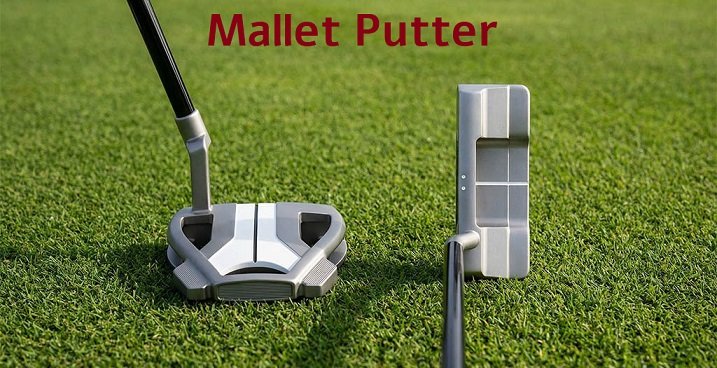
A mallet putter is a kind of golf putter diagnosed by way of its larger and commonly wider clubhead as compared with a conventional blade putter. Mallet designs are famous due to the fact the larger head permits manufacturers to distribute more weight around the perimeter, growing balance and resistance to twisting on off-middle strikes. Many mallet putters also provide prominent alignment aids, making them attractive to golfers who want extra assist placing the clubface rectangular to the goal line.
Putting is one of the most vital parts of golfing because each hole in the end ends on the putting green. A golfer can hit exceptional drives and method pictures, but terrible placing can nonetheless bring about a high score. The right putter cannot routinely make every putt, however its head design, balance, weight distribution, alignment features, duration, grip and experience can influence consistency and confidence.
This guide explains what a mallet putter is, the way it works, its advantages and disadvantages, the difference between mallet and blade putters, and the essential elements to keep in mind earlier than shopping for one.
What Is a Mallet Putter?
A mallet putter has a bigger clubhead than a conventional blade putter. Instead of concentrating most of the top mass without delay in the back of the placing face, many mallet designs extend the top farther backward and distribute weight across the perimeter.
This large structure offers designers greater room to comprise capabilities along with:
- Alignment traces
- Dots and contrasting shapes
- Perimeter weighting
- Interchangeable or adjustable weights on a few fashions
- High-MOI production
- Different hosel configurations
- Various face technology
- Larger or counterbalanced grips
Modern mallet putters may have many exceptional shapes. Some are rounded, some are rectangular or square, whilst others use winged or futuristic designs. Therefore, “mallet” describes a broad class in place of one unique form.
Why Are Mallet Putters So Popular?
One foremost cause is balance.
When a golf ball is struck far from the middle of a putter face, the clubhead can twist. A layout with more second of inertia (MOI) commonly resists that twisting greater correctly. Many mallet putters use their large head and perimeter weighting to increase MOI, helping reduce the results of some off-middle strikes.
Mallet putters are also famous due to the fact their large top floor offers producers greater area to create visible alignment systems. For golfers who have issue aiming the putter face efficaciously, these alignment features may be specifically beneficial.
However, a mallet putter isn’t automatically higher for every golfer. Putting stroke, balance, visible preference, feel and setup all be counted.
Key Features of a Mallet Putter
The following desk summarizes some of the maximum essential characteristics.
| Feature | Mallet Putter Characteristics |
|---|---|
| Head size | Generally larger than a traditional blade |
| Weight distribution | Often distributed toward the perimeter |
| MOI | Typically higher than traditional compact designs |
| Forgiveness | Generally high, particularly on off-center strikes |
| Alignment aids | Usually more extensive |
| Balance | Many models are face-balanced or have limited toe hang, but designs vary |
| Stroke compatibility | Often suitable for straight-back, straight-through strokes; toe-hang mallets can suit arcing strokes |
| Appearance | Larger and more substantial at address |
| Feel | Depends heavily on materials and face construction |
| Best use | Golfers seeking stability, alignment assistance and forgiveness |
It is important to consider that those are general characteristics. Modern putter designs have come to be fairly various, so now not each mallet follows the traditional sample.
Mallet Putter and MOI
MOI, or moment of inertia, is an vital term when discussing putter forgiveness.
In simple phrases, MOI describes a clubhead’s resistance to twisting when a force is applied faraway from its middle of mass. A better-MOI design can be greater resistant to twisting than a lower-MOI design.
For putting, this matters due to the fact golfers do now not usually strike the precise middle of the face.
For example, consider putts which might be intended to journey exactly closer to the same goal. If one strike is targeted and every other is barely closer to the heel or toe, a more solid putter can assist reduce the amount of unwanted face rotation as a result of that mishit.
That does no longer imply a excessive-MOI mallet will accurate every terrible stroke. Face perspective, direction, effect location, inexperienced reading and pace control still have essential outcomes at the end result.
Alignment Benefits of a Mallet Putter
Alignment is one of the most powerful motives golfers choose a mallet.
A larger mallet head presents extra space for producers to feature visual alignment systems. These can include:
- Long sightlines
- Short sightlines
- Parallel alignment tracks
- Dots
- Geometric shapes
- Contrasting sections
- Rear alignment bars
These capabilities can assist golfers visually role the face relative to the supposed beginning line.
The first-class alignment gadget is rather personal. One golfer may additionally pick a single immediately line, whilst some other may additionally discover a massive geometric design easier to use.
Before shopping for a mallet, it’s miles therefore useful to location it in the back of a golf ball and take a look at it out of your normal setting role.
Face-Balanced vs Toe-Hang Mallet Putters
One not unusual misconception is that each mallet putter is face-balanced. That isn’t actual.
Many mallets are face-balanced or near face-balanced, however current designs also can have toe grasp.
What Is a Face-Balanced Putter?
A face-balanced putter is designed so that once the shaft is balanced horizontally, the putter face usually factors upward.
Face-balanced designs are normally associated with setting strokes that have relatively little face rotation and move extra immediately returned and thru.
What Is Toe Hang?
A toe-hold putter has the toe pointing downward to some degree while the putter is balanced on its shaft.
Toe hang may be useful for golfers whose herbal stroke has greater arc and face rotation.
The vital factor is that head form by myself should not decide your preference. A golfer need to bear in mind the balance characteristics of the precise model.
Mallet Putter vs Blade Putter
The distinction among mallet and blade putters is one of the most not unusual gadget discussions in golf.
A conventional blade has a highly compact head, even as a mallet has a larger footprint. Blades frequently emphasize a traditional appearance and direct feedback, whereas mallets commonly emphasize stability and alignment assistance.
| Category | Mallet Putter | Blade Putter |
| Head profile | Large and deep | Compact and relatively thin |
| Stability | Generally high | Generally lower |
| MOI | Often higher | Generally lower |
| Alignment aids | Usually prominent | Often simpler |
| Forgiveness | Generally greater | Generally less |
| Traditional appearance | Less traditional | More traditional |
| Stroke compatibility | Often face-balanced or slight hang | Often toe-hang, although exceptions exist |
| Best choice | Golfers seeking stability and alignment help | Golfers preferring compact shape and feedback |
Neither style is universally better.
The best putter is the one that facilitates a particular golfer constantly start the ball at the supposed line and control its speed.
Advantages of a Mallet Putter
1. High Stability
A main advantage of many mallet designs is stability. Perimeter weighting and large head construction can increase resistance to twisting on off-middle affects.
2. Strong Alignment Assistance
The large head gives manufacturers more room to include alignment generation. This can be treasured for golfers who warfare to purpose their putter efficaciously.
3. Forgiveness
Mallet putters are commonly selected by using golfers who want greater forgiveness. When a putt is struck barely faraway from the center, a solid head can assist preserve more constant face behavior and ball pace than a less-forgiving design.
4. Confidence at Address
Some golfers simply sense more confident looking down at a larger putter head. Confidence is crucial because placing requires a repeatable setup and stroke.
5. Wide Range of Designs
Modern mallet putters are available in numerous shapes and balance configurations. Golfers can consequently locate models designed for exceptional strokes and choices.
Disadvantages of a Mallet Putter
Despite their advantages, mallet putters are not ideal.
1. Larger Appearance
Some golfers dislike the larger profile. If a player prefers the clean, compact appearance of a blade, a large mallet may additionally experience distracting.
2. Feel Can Be Different
Many golfers partner blades with a extra direct effect sensation. Some mallets can produce a softer or greater muted experience, even though this relies upon heavily on the face insert, materials and production.
3. Alignment Can Become Too Busy
Alignment generation is useful simplest while it enables. Some golfers discover complicated pictures distracting in preference to useful.
4. Not Every Mallet Fits Every Stroke
A golfer with a mentioned putting arc may not robotically advantage from a face-balanced mallet. Toe hold and hosel layout ought to be taken into consideration.
Who Should Use a Mallet Putter?
A mallet putter may be really worth considering if you:
- Frequently omit the center of the putter face
- Want more stability
- Have trouble aiming the putter
- Prefer a bigger clubhead
- Like outstanding alignment aids
- Have a notably straight setting stroke
- Want a present day putter design
- Prefer a solid experience for the duration of the stroke
Mallets are not confined to beginners or high-handicap golfers. Professional golfers additionally use mallet designs. TaylorMade, for example, notes that essential championship winners which include Scottie Scheffler and Rory McIlroy have used mallet putters.
How to Choose the Right Mallet Putter
Choosing a mallet have to involve extra than selecting the maximum steeply-priced model.
1. Check Your Putting Stroke
First decide whether your stroke is particularly directly or has a great arc.
If your stroke has extensive face rotation, inspect mallets with appropriate toe cling in preference to assuming each mallet is face-balanced.
2. Test Alignment
Place the putter behind a ball and goal at a target. Check whether or not the alignment device makes it easier or tougher a good way to aim.
3. Test Distance Control
Try short putts and lengthy lag putts. A putter that feels amazing on six-foot putts might not always give you the self belief you want on 30- or forty-foot putts.
4. Consider Head Weight
Head weight influences the way the putter feels all through the stroke. Some golfers opt for a heavier head because it feels strong, at the same time as others decide on a lighter sensation.
5. Choose the Correct Length
Putter duration ought to permit you to establish a cushtly posture and repeatable setup. Avoid selecting period completely because a selected professional golfer uses it.
6. Pay Attention to Grip Size
A large grip can exchange how the putter feels in the hands and might lessen excessive hand motion for some golfers. Grip preference is extraordinarily individual.
7. Compare Feel
Try exceptional face materials and constructions. The sound and experience at effect can affect confidence and distance manipulate.
Are Mallet Putters Legal?
Mallet putters may be utilized in opposition when the individual club conforms to the applicable Rules of Golf and system specifications.
The USGA defines a putter as a membership with loft not exceeding 10 levels this is designed typically for use at the setting green.
The USGA additionally provides equipment requirements protecting membership construction, dimensions, grips and other traits. Therefore, golfers participating in competitions must verify that their precise putter version conforms to the applicable rules rather than assuming that each unusual-looking design is mechanically prison.
Mallet Putter Buying Checklist
Before shopping a mallet putter, remember the following:
- Head form: Does the form appearance snug in the back of the ball?
- Alignment: Can you effortlessly purpose it at your intended target?
- Balance: Is it face-balanced or toe-hold?
- Stroke: Does its stability suit your herbal stroke?
- MOI: Do you need most stability?
- Feel: Do you want the impact sensation?
- Weight: Does the top sense cushty?
- Length: Does it allow a repeatable setup?
- Grip: Does the grip feel steady and cushty?
- Price: Does it provide price to your desires?
- Rules: If you compete, is the exact version conforming?
Frequently Asked Questions About Mallet Putters
Is a mallet putter better than a blade?
Not necessarily. A mallet can provide more balance and greater alignment assistance, even as a blade can also appeal to golfers who pick a compact appearance and sturdy comments. The right preference relies upon on the golfer’s stroke and alternatives.
Are mallet putters appropriate for novices?
They may be. The balance and alignment capabilities discovered in many mallet designs may be useful for golfers who’re learning to broaden a consistent setting stroke.
Are mallet putters greater forgiving?
Generally, many mallet designs are greater forgiving because their larger heads allow weight to be dispensed in methods that boom balance and MOI. However, forgiveness varies among character models.
Is a mallet putter suitable for a high-handicap golfer?
Yes. A high handicap does now not prevent a golfer from the use of a mallet. In fact, golfers who battle with alignment or off-middle contact may also admire the steadiness and visual help.
Can a sophisticated golfer use a mallet putter?
Absolutely. Mallet putters are utilized by golfers at every skill stage, together with professionals.
Are all mallet putters face-balanced?
No. Although many mallet putters are face-balanced or near face-balanced, modern mallets may have specific amounts of toe hold.
Final Thoughts
A mallet putter is a versatile golf membership design that emphasizes stability, forgiveness and alignment. Its larger head gives manufacturers more opportunities to position weight around the perimeter and create alignment capabilities. These traits can make mallet putters particularly attractive to golfers who need a strong clubhead and extra visual help when addressing the ball.
However, buying a mallet clearly because it is marketed as “forgiving” isn’t always enough. Your putting stroke, stability choice, head form, alignment desires, sense, duration and grip need to all be taken into consideration.