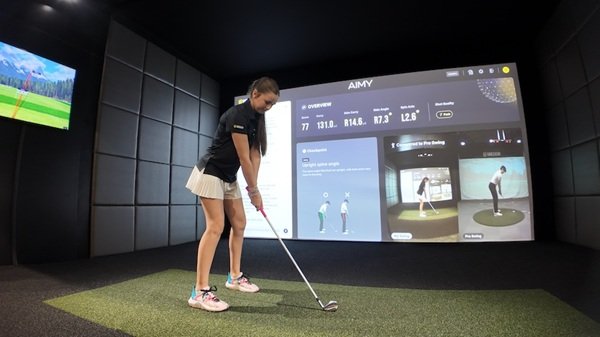
Most amateurs practice the wrong way. They hit a bucket at the range, feel good about a handful of clean strikes, then watch those gains disappear on the first tee. Time, weather, and fading daylight all make it hard to get in consistent reps. Golf simulators promise something different: measured, repeatable practice you can do at home in any season. The real question is whether the technology earns its place in your training.
How golfers are training differently now
The way people improve at golf has changed more in the last decade than in the thirty years before it. According to the National Golf Foundation, over 19 million Americans now play golf exclusively away from the course, at tech-enabled ranges, indoor simulators, and entertainment venues. For several years running, that off-course activity has outpaced the number of traditional rounds played on grass.
A few things are driving the move indoors:
- Practice no longer waits on the weather, the season, or daylight hours.
- Every shot returns instant data instead of a vague sense that something felt okay.
- A meaningful session can fit into twenty minutes at home, with no tee time required.
For the everyday golfer, the appeal is practical. A session does not hinge on a tee time, good light, or a dry forecast, and the price of a capable setup keeps dropping as the hardware improves. Indoor practice has gone from a luxury to a realistic option for ordinary players.
Building a setup that translates to the course
A simulator is only as good as the way it is built around your space. The headline device is the launch monitor, the sensor that reads your shot. Around it sit the parts that turn data into a round you can actually play: an impact screen, an enclosure, a hitting mat, a projector, and the software that renders the course.
Get the balance wrong, and the experience suffers. A premium launch monitor firing into a flimsy net in a low-ceilinged garage will frustrate you within a week. Because the components matter more than any single box, a number of specialist suppliers now focus on matching the screen, mat, and sensor to a golfer’s room and budget rather than selling one fixed package. Golfbays, a UK family-run company whose enclosures are rated to handle ball speeds north of 200 mph and are used by PGA professionals, is one example of that consultative approach.
Getting the setup right pays off with honest feedback. Because a simulator records carry and total distance for every club you hit, it quickly exposes the real gaps in your bag, which is useful context if you are still learning what each type of golf club is designed to do. Most golfers discover that their 4-iron and 5-hybrid travel the same distance or that their “150 club” is actually a 140 club. That kind of detail is hard to learn on a range with painted yardage boards and second-hand balls.
Can you trust the numbers a simulator gives you?
This is the question that decides whether a simulator is a toy or a training tool. If the data is wrong, you are grooving your swing toward a target that does not exist.
The good news is that independent testing backs the better systems. A 2024 study published in the Journal of Sports Sciences tested the Trackman 4 launch monitor across multiple sessions with skilled golfers and found its readings reliable and repeatable enough to trust in real practice. For the metrics that matter most to ball flight, accuracy was high.
Here is what a quality launch monitor measures and why each number is worth watching:
| Metric | What it tells you | Why it matters |
| Ball speed | How fast the ball leaves the face | The single biggest driver of distance |
| Launch angle | The vertical launch angle of the ball | Controls trajectory and carry |
| Spin rate | Backspin on the ball | Too much costs distance, too little kills stopping power |
| Club path | The club’s swing path through impact | Explains your shot shape |
| Face angle | Where the face points at impact | The main cause of slices and hooks |
| Carry distance | How far the ball flies before landing | Builds an accurate yardage map per club |
The caveat is that not all units are equal. Entry-level monitors are reliable on ball speed and carry but get shakier on spin and angle of attack, where small errors creep in. For swing changes you can trust, the sensor is the part of the setup worth spending the most on.
The strongest vote of confidence comes from the professional game itself. Top players now compete in simulator-based formats, and the strategy that drives indoor leagues like TGL only works because everyone trusts the numbers on the screen to be fair and accurate.
Where simulators still fall short
For all their strengths, simulators do not replace the course, and any fair assessment should say why.
The clearest limit is competitive. Scores you post indoors do not count toward your official handicap. The World Handicap System only accepts rounds played on a course with a current Course Rating and Slope Rating, neither of which a simulator carries. Your screen rounds can be brilliant, but they will not move your Handicap Index.
There is also the matter of feel. A mat is forgiving in ways real turf is not. It does not punish a fat strike the way a tight fairway lie will, and it cannot recreate an awkward stance on a slope, a ball sitting down in rough, a swirling crosswind, or the nerves of a real card. Putting is often the weakest part, since rolling a ball into a screen rarely matches the read and pace of a real green.
Then there is cost and space. A serious setup needs a dedicated room with enough ceiling height to swing a driver, and prices climb quickly once you move past the most basic kit. For many golfers, the sensible first step is a launch monitor and a net, with the full screen and enclosure added later.
None of these factors makes the technology a gimmick. It just means a simulator is a training and practice tool, not a one-to-one substitute for eighteen holes.
So, are simulators the future of golf training?
They are already a large part of it. Simulators won’t replace grass, sea breeze, and a real scorecard, and most golfers wouldn’t want them to. As a way to practice with purpose, though, they have moved from novelty to mainstream, and the data they produce keeps getting more trustworthy. The future of golf training looks less like choosing between the range and the screen and more like using both, with the simulator handling the measured, repeatable work that turns a decent swing into a reliable one.