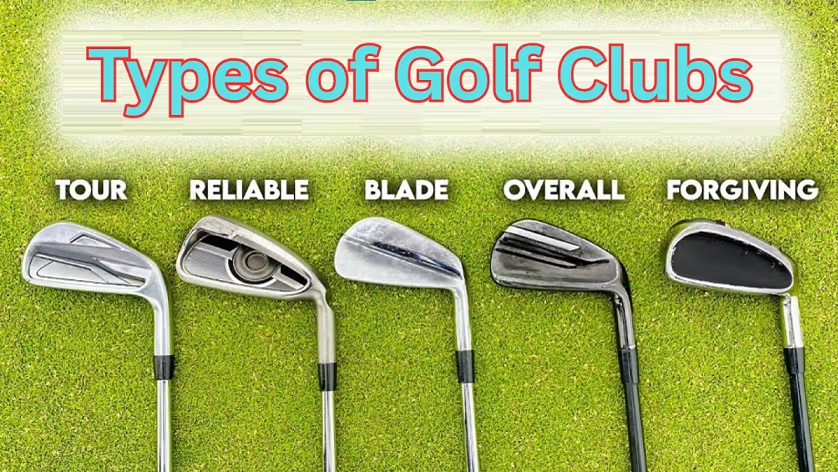
Types of Golf Clubs
Golf is a recreation of precision, patience, and Ardour — and on the coronary heart of it lies one crucial element: golfing clubs. Whether you’re a amateur teeing off for the first time or a professional chasing that ideal swing, know-how the exclusive styles of golf clubs is essential for improving your performance.
This comprehensive manual breaks down every class of golf club, which includes drivers, woods, irons, wedges, hybrids, and putters. You’ll also find out about loft angles, materials, membership selection tips, and a way to construct an appropriate golf bag.
1. Introduction to Golf Clubs
A golf membership is not only a stay with a head — it’s a bit of precision equipment designed to manipulate distance, direction, and trajectory. Golf clubs are divided into several types, each crafted for specific pictures. From hitting long distances off the tee to executing delicate chips near the green, every club has a completely unique function.
A standard golf set normally consists of:
- 1 Driver
- 3-5 Woods or Hybrids
- 7–9 Irons
- 3–4 Wedges
- 1 Putter
Each has its personal shaft duration, loft, and head layout, all influencing how the ball behaves on effect.
2. Overview Table: Types of Golf Clubs and Their Uses
| Type of Golf Club | Main Use | Typical Loft (Degrees) | Average Distance (Yards) | Common Materials |
|---|---|---|---|---|
| Driver (1-Wood) | Long-distance shots off the tee | 8–13° | 200–300+ | Titanium, Graphite |
| Fairway Woods (3, 5, 7) | Long-range fairway shots | 13–22° | 180–250 | Steel, Carbon, Titanium |
| Hybrids | Replacing long irons | 18–27° | 150–220 | Graphite, Stainless Steel |
| Irons (3–9) | Mid-range to approach shots | 20–45° | 100–200 | Carbon Steel, Graphite |
| Wedges (PW, SW, LW) | Short approach and chip shots | 45–64° | 50–130 | Forged Steel |
| Putter | Rolling the ball on the green | 2–5° | — | Stainless Steel, Aluminum |
3. Drivers (1-Wood): Power Off the Tee
The driving force is the most iconic club in golf — constructed for maximum distance. It’s used at the tee field to make the opening shot on long holes.
Key Features:
- Largest clubhead to your bag.
- Low loft among 8–13°.
- Longest shaft — usually 43 to 46 inches.
- Designed to hit the ball off a tee, not the ground.
Best Use:
When you want to cover maximum floor in a single shot — specifically on par 4 and par 5 holes.
Expert Tip:
Beginners should pick a motive force with a better loft (round 10.5°–12°) to help raise the ball without problems and reduce sidespin.
4. Fairway Woods: Distance and Control
Fairway woods (3-timber, 5-wood, and 7-wood) are built for distance shots from the golf green or tight lies. They provide a good stability of distance and forgiveness.
Features:
- Smaller heads than drivers however nevertheless large enough for strength.
- Can be used off the floor or from a tee.
- Common lofts: 3-wood (13–15°), 5-timber (17–19°), 7-wooden (21–22°).
Best Use:
Ideal for 2nd pictures on long par 5s or while accuracy is wanted greater than pure electricity.
Example:
Many professional golfers use a 3-timber for tighter tee shots in which the driver may threat going out of bounds.
5. Hybrids: The Modern Solution to Long Irons
The hybrid membership is a contemporary invention that blends the accuracy of irons with the ease of hitting of woods. They’re designed to replace long irons (2, 3, 4), which many gamers discover tough to apply.
Features:
- Compact head with a rounded sole for clean turf interplay.
- Lofts among 18° and 27°.
- Designed to release the ball better with much less attempt.
Advantages:
- Easier to hit than long irons.
- Excellent for rough and choppy lies.
- Consistent ball flight with improved forgiveness.
Best Use:
Use hybrids while you want a managed, lengthy shot however conflict with long irons.
6. Irons: The Backbone of Your Golf Bag
Irons are the most flexible kind of golf equipment and make up the bulk of a participant’s set. They are numbered from 3 to 9, with every better quantity representing greater loft and shorter distance.
| Iron Number | Typical Loft (Degrees) | Average Distance (Yards) | Usage |
|---|---|---|---|
| 3-Iron | 20–23° | 180–210 | Long approach shots |
| 4-Iron | 23–26° | 170–200 | Long fairway shots |
| 5-Iron | 26–30° | 160–190 | Medium distance shots |
| 6-Iron | 30–34° | 150–180 | Controlled approach shots |
| 7-Iron | 34–38° | 140–170 | Accurate mid-range shots |
| 8-Iron | 38–42° | 130–160 | Short approach |
| 9-Iron | 42–45° | 120–150 | High-trajectory approach |
Types of Irons:
- Cavity-again Irons: Forgiving and ideal for beginners.
- Blade Irons (Muscle-back): Preferred by using experts for control.
- Game Improvement Irons: Combine distance and forgiveness.
7. Wedges: Precision Tools Around the Green
Wedges are specialized irons designed for excessive, quick-distance pictures. They have the maximum lofts amongst golfing golf equipment and are vital for technique play, chipping, pitching, and escaping bunkers.
Main Types of Wedges:
| Wedge Type | Loft Range (°) | Main Use |
|---|---|---|
| Pitching Wedge (PW) | 45–49° | Full approach shots from 100–130 yards |
| Gap Wedge (GW) | 50–54° | Bridging distance between PW and SW |
| Sand Wedge (SW) | 54–58° | Escaping bunkers and soft lies |
| Lob Wedge (LW) | 58–64° | High-arc short shots near the green |
Expert Tip:
Always healthy your wedge gapping — preferably, there ought to be 4°–5° distinction among each wedge loft for regular distance manipulate.
8. Putter: The Club for the Final Stroke
The putter is used on the green to roll the ball into the hole. It’s the most frequently used membership on your bag — accounting for over 40% of your total strokes in an ordinary round.
Putter Types:
- Blade Putter – Classic, easy design for precision putts.
- Mallet Putter – Larger head, more forgiving, allows with alignment.
- Peripheral-weighted Putter – Combines each capabilities for balance and manipulate.
Best Use:
For quick, correct strokes in which manage and contact matter greater than electricity.
9. Specialty Golf Clubs
Some golfers carry area of expertise clubs for particular conditions:
| Club Type | Purpose |
|---|---|
| Driving Iron | For windy conditions; offers low trajectory control |
| Chipper | For bump-and-run shots near the green |
| Long Putter | For players with putting yips or back issues |
| Rescue Club | Versatile for rough, sand, or tight lies |
10. Golf Club Loft and Distance Chart
| Club Type | Typical Loft (°) | Men’s Average Distance (Yards) | Women’s Average Distance (Yards) |
|---|---|---|---|
| Driver | 8–13 | 220–300 | 150–230 |
| 3-Wood | 13–15 | 200–250 | 130–190 |
| 5-Wood | 17–19 | 180–220 | 110–170 |
| 4-Iron | 23–26 | 170–200 | 100–160 |
| 7-Iron | 34–38 | 140–170 | 80–130 |
| Pitching Wedge | 45–49 | 110–130 | 60–100 |
| Sand Wedge | 54–58 | 80–100 | 50–80 |
| Putter | 2–5 | — | — |
11. How to Choose the Right Golf Clubs
Choosing the proper set relies upon for your ability level, swing speed, and playing fashion.
Beginners:
- Use forgiving cavity-back irons.
- Choose a high-lofted driving force (10.5°–12°).
- Include hybrids rather than long irons.
Intermediate Players:
- Mix forgiveness and manage (sport improvement irons).
- Add a hole wedge for better distance insurance.
Advanced Players:
- Prefer blade irons for remarks and precision.
- Carry multiple wedges for special conditions.
12. Club Materials: Steel vs Graphite
| Material | Benefits | Ideal For |
|---|---|---|
| Steel Shafts | Durable, consistent feel | Skilled players seeking control |
| Graphite Shafts | Lightweight, increases swing speed | Beginners or players with slower swings |
| Titanium Heads | Lightweight, strong, powerful | Drivers and woods |
| Forged Iron Heads | Soft feel, better feedback | Professionals |
13. Building the Perfect Golf Club Set
A balanced golf bag consists of a mix of clubs for all conditions:
| Category | Suggested Clubs |
|---|---|
| Long Game | 1 Driver, 1 Fairway Wood, 1 Hybrid |
| Mid Game | 4–6 Irons |
| Short Game | Pitching, Gap, Sand, and Lob Wedges |
| Putting | 1 Putter |
14. Golf Club Maintenance Tips
- Clean grooves after every round.
- Store clubs in a dry environment.
- Re-grip your golf equipment yearly.
- Check shaft alignment regularly.
Proper protection guarantees longer life and steady performance.
15. Frequently Asked Questions (FAQ)
Q1: How many golf equipment are allowed in a golfing bag?
A participant can carry up to 14 golf equipment in a single round, as in step with USGA and R&A rules.
Q2: What is the very best club to hit for novices?
A 7-iron or hybrid is taken into consideration the very best for maximum beginners.
Q3: What’s the distinction between woods and irons?
Woods have large heads and are supposed for long pictures, while irons are used for mid to brief-variety shots.
Q4: Should I buy man or woman golf equipment or a complete set?
Beginners should begin with a half set or blend set, whilst superior players can customise each membership.
16. Conclusion: Master Your Game with the aid of Understanding Your Clubs
Understanding the styles of golfing golf equipment is the inspiration of becoming a better golfer. Each club performs a unique role in your strategy — from the effective driver to the ideal putter. By learning a way to pick out and use them efficiently, you’ll no longer simplest enhance your accuracy but also expand the confidence to stand any challenge on the path.